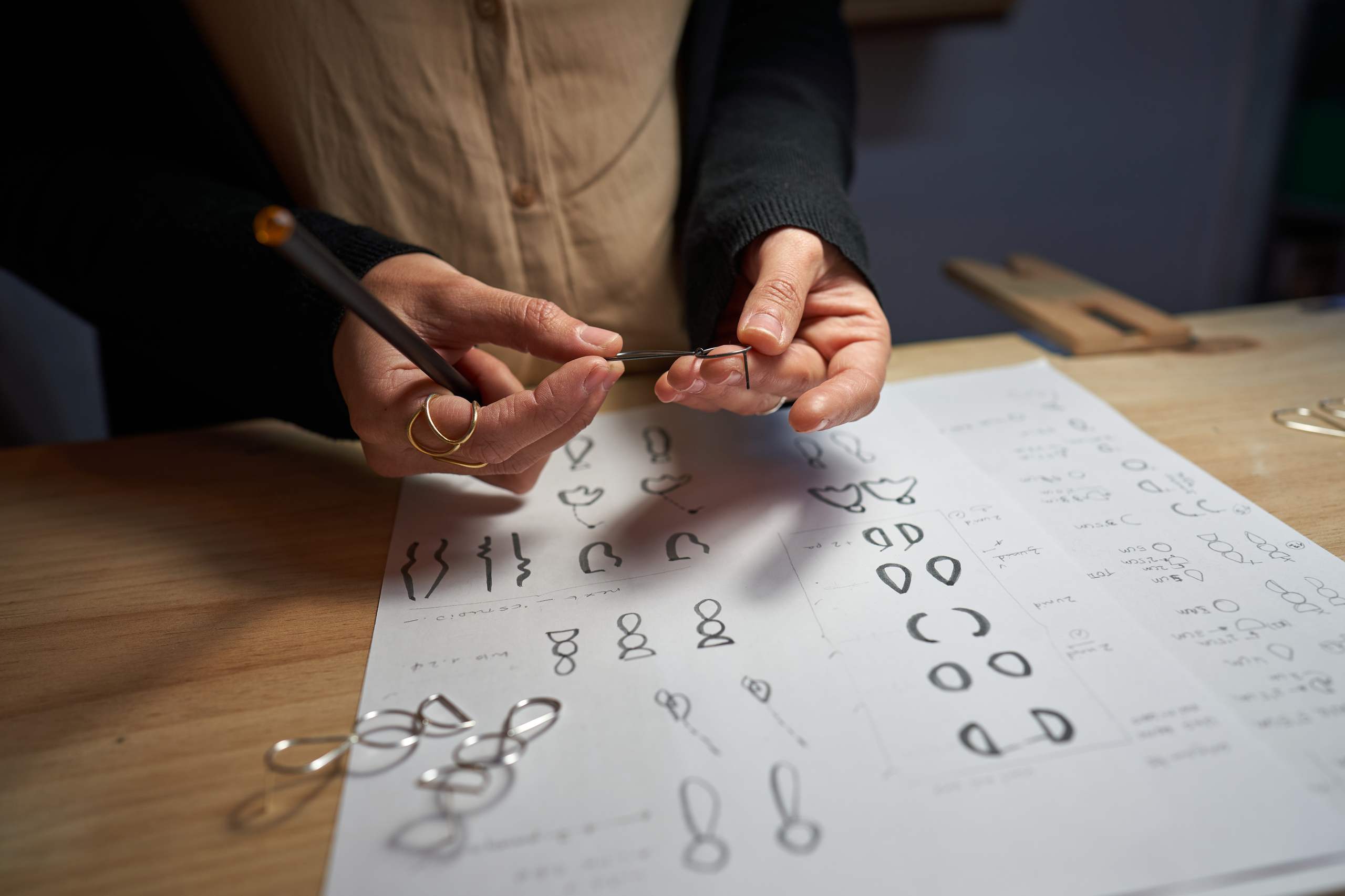
Gemstones have been an integral component of jewelry for centuries. In contemporary design, though, they are rarely treated as mere finishing details. Often, a gemstone is the genesis of a project: the concept for the whole piece. A gemstone can determine shape, structure, proportion, or mood of the design. It is not an optional extra; it is the beginning point.
When working with a stone, it starts with observation, not execution. The design idea does not come simply from the thought, “This is a pretty stone.” Rather, the designer considers the gemstone’s visual communication, its intensity of color, degree of transparency, quality of texture, nature of its play of light, etc. Some gemstones are very quiet and reserved, other stones are quite bold and dramatic, and these characteristics often serve as the foundation of a design.
It is common for gemstones to assume the role of an organizing force in the piece. The focal point of a design may be defined by a single large or colorful stone. In this case, the result is likely to be a clear, focused design. Alternatively, a composition can be developed from the arrangement of multiple smaller stones. In this case, the design is more likely to have a sense of motion or rhythm to it. Regardless of the outcome, the gemstone is the underlying logic of the design.
The designer’s selection of a gemstone can also reflect an added layer of meaning. In this way, the design can evolve from jewelry into something with more personal connotation and symbolism. The idea might be for a gemstone to stand for “strength,” “remembrance,” “transition,” or “bond,” for example. Even if a client doesn’t explicitly see the meaning, she will subconsciously feel it. In this way, the jewelry takes on additional value beyond simply being an attractive object.
A good understanding of the material is essential for a designer to work successfully with gemstones. Stones have distinct characteristics such as hardness, fragility, reaction to light, and setting suitability, and these are factors that impact the design. It might be that an excellent idea must be adjusted if the stone in question cannot be successfully set or comfortably worn. This is where art meets engineering.
Modern tools have increased the capabilities of design as well. New technologies such as digital modeling and visualization allow designers to play around with a gemstone’s position during the design process. This can facilitate the exploration of ideas or avoid costly mistakes. It can also raise expectations and challenges.
Gemstones can be much more than the end result of a piece of jewelry; they are the starting point, the emotional anchor, and the building block. Learning how to work with a gemstone is the same as learning how to transform the raw beauty of nature into an intentional wearable object.